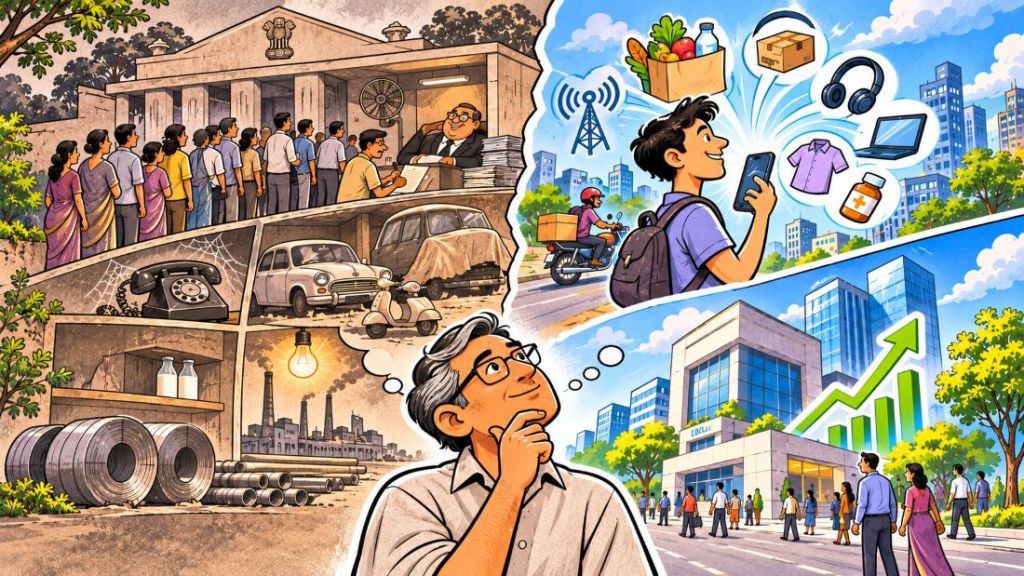
People of my generation will remember an era of shortages and lack of opportunity. There was not enough milk, butter, food, nor electricity, steel, and aluminium. To get a telephone or gas connection, two-wheeler or car, meant a waiting list in years (yes, not days or months, but years). Unless, of course, you had “contacts”.
The government decided who could produce what, and in what quantity. Incumbent business houses made a lot of money selling sub-standard goods that were in short supply. And we created government monopolies in banking, telecom, airlines, mining, metals and many other sectors – all in the name of public interest.
Fast forward to 2026. Today’s youth (at least in urban India) does not know what shortages mean. Zip out your phone, click a few buttons and an astonishing range of products arrives in minutes. A telephone call costs a (tiny) fraction of what it did in the eighties, and serves more than 30x the number of people.
Much of this is due to the liberalization that began in the early nineties, and has continued since. The end of the “License Raj” helped unleash entrepreneurial energy, competition did the rest. It’s interesting that many of the erstwhile biggest business houses that could not compete have withered.
And this is why I find it hard to reconcile today’s opposition to reform and privatization. Our economy is modern, but our thinking is still stuck in the sixties. Or at least that of many politicians, and not just those in the opposition.
The immediate trigger for this article is the opposition to the sale of IDBI Bank.
Once upon a time, it may have been necessary for the government to run banks, steel plants, power plants, telecom companies, or coal mines. But today? When we have a private sector with the ability to fund and manage these complex enterprises?
This is not to say that the public sector lacks capabilities. However, the incentives for managers of these enterprises are not aligned to making things more efficient, cheaper and increasingly available to all.
Let’s look at banking. Government ownership led to inefficiency, poor lending norms and slow decision making – culminating in a huge financial crisis during 2009-14. Many PSU banks were near bankrupt, due to a surfeit of bad loans made to suspect businesses (some of which were politically connected).
At the end of FY18, gross NPAs at public sector banks touched 14.6% of advances, or almost ₹9 lakh crore. The government had to commit several lakh crores to keep these banks afloat. That public capital could have been deployed elsewhere.
Fortunately, stricter rules and oversight by the regulator (RBI), the Insolvency and Bankruptcy Code and better credit discipline have helped PSU banks turn profitable. But this does not address the question of why the government needs to own banks. And whether this is the best use of taxpayer money.
HDFC, ICICI, and Kotak demonstrate private capability to run giant, complex institutions. This is not to say that private banks cannot go bust – Yes Bank, Global Trust and Lakshmi Vilas Bank are testimony to that.
But regulation and ownership are two different things. The government can (and must) regulate business in a transparent manner, and ensure compliance with norms like rural lending, inclusion, reserve ratios, etc. And the RBI has proven its capabilities in this regard.
Good governance does not necessarily equal ownership. In other words, the ability to regulate should not be confused with the need to own everything.
The other argument centers around selling government (or public) assets to “greedy” private sector players. But this is simply short-sighted, and ignores the post-privatization successes of VSNL, Hindustan Zinc, and Balco. All these contribute far more to the economy – in investments, taxes, production – than they did under government ownership.
In contrast, the once thriving MTNL was worth ~₹24k crores in 2000. At the time, many would have paid a premium to acquire it. Today, market cap is ₹1,550 crore, net worth is negative ₹30k crore, and ₹3k crore of public money is lost every year.
Why?
I don’t deny that strategic government ownership in select sectors may be required. But times change, as does the definition of what is strategic.
The government should focus on areas where markets don’t work well, or which need subsidization – for instance, education, defence, critical infra, public transport and healthcare. But if they keep running inefficient white elephants from a past era, where will the money come from?
It’s sad that despite so much evidence (and there’s much more than this brief article can provide), the political class keeps treating ownership as a holy cow.
Public interest is paramount, but does public ownership guarantee that?

Leave a Reply