Nation Building: The Stories We Don’t Tell
Earlier this week, I attended the National Conference on Social Innovation (NCSI), organised by the Pune International Centre (PIC). The event showcased the efforts of twelve social entrepreneurs and innovators, selected from over a hundred applicants.
From helping children caught in conflict zones and improving access to mental healthcare, to educating disadvantaged children, improving animal health and tackling air pollution, the range of problems being addressed was remarkable.
Through the day, listening to these inspirational stories and hearing about the challenges they face, I kept wondering about the people behind these organisations. Many have given up lucrative careers; and often work in remote, underdeveloped parts of the country, taking on difficult challenges that offer little financial reward or public recognition
We spend a lot of time celebrating India’s growing start-up ecosystem and entrepreneurs. We track what they do, how much wealth they create, how many people they employ, and celebrate these successes. This is all to the good, and much needed.
But there is another set of entrepreneurs whose contribution receives far less attention.
Today, thousands of Indians are building organisations and institutions – not to make money, but to address deep-rooted social and economic problems. They work in education, health, rural development, livelihoods, environment and many areas that neither markets nor the government have been able to address. Is this not equally critical to our aspirations for a Viksit Bharat?
As per NITI Aayog, more than 5 lakh non-profits were registered on the “Darpan” database as of May 2026. However, many more are not registered. Some estimate the total number to exceed 3 million. Research by Dasra (Indian Non-Profit Report 2026) suggests that they employ as many as 16 million people. That’s not a trivial number, especially considering how little attention the sector receives in discussions about employment, entrepreneurship and economic contribution.
And NGOs have a multiplier effect that is not always appreciated, and difficult to measure. Educating children contributes to the future workforce. Improving health outcomes improves productivity. Ensuring women become financially independent creates many new entrepreneurs. Improving livelihoods means that subsidies may not be needed in future. I could go on and on…
Traditionally, philanthropy in India was largely associated with a few wealthy industrialists, religious institutions and charitable trusts. But this has changed dramatically. More and more successful entrepreneurs are setting up foundations to fund such enterprises.
CSR has also emerged as a powerful source of finance. According to the Ministry of Corporate Affairs, CSR funding exceeded ₹40,000 crores in FY25. This is almost 4 times what it was in FY15, clocking a CAGR of 15%.
Interestingly, an entire support ecosystem is also developing. Social sector enablers like incubators, accelerators, impact investors, advisors and capacity-building institutions are helping formalize the sector, and imbibe a more professional set of operating principles.
Today not-for-profit enterprises speak the language of metrics, accountability and scalability. They look to build leadership teams that go beyond a passionate founder. They are learning that finance, narrative building and compliance are essential to their success. And they increasingly attract talented young professionals.
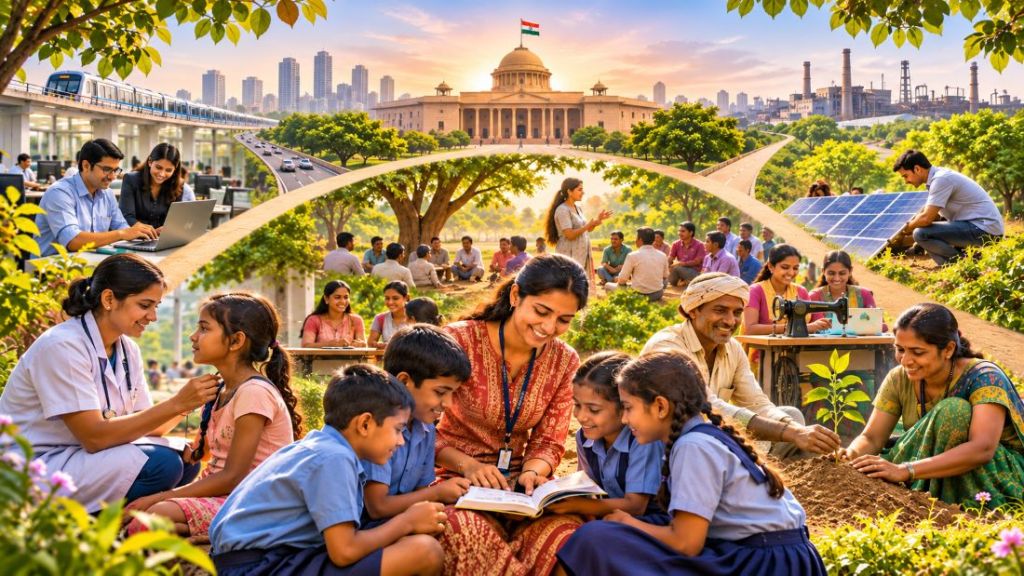
We tend to think of nation building in terms of roads, ports, power, factories, hospitals, airports, metros and such types of hard, visible symbols. But our future depends on the well-being, education and living standards of our people – these soft factors are equally, if not more important.
What’s heartening is that many of our youth are looking for “meaningful” careers that can “make a difference”. And they’re either starting social enterprises, or want to work in one or volunteer their skills. This is a significant cultural shift, and very different from earlier generations.
Nation building is not just about physical infrastructure, but also about social infrastructure. The contributions of people and organisations doing this work deserve far greater recognition. And initiatives like PIC’s conference need to be applauded and emulated.

Leave a Reply