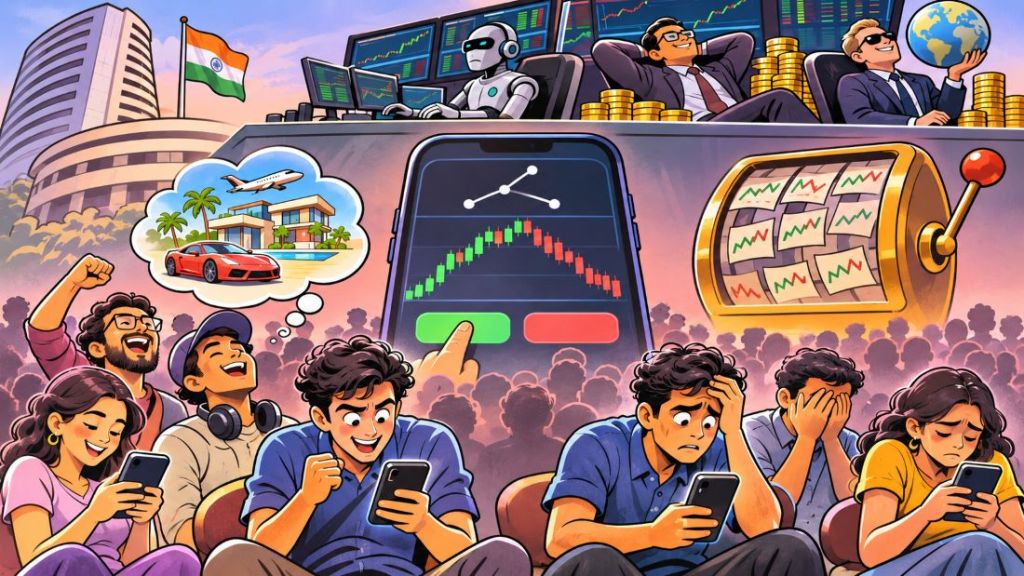
India is now the world’s largest derivatives market by number of contracts traded. The NSE alone accounted for more than half of global equity derivatives contracts traded in FY26. And a whopping 8.75 million Indians traded in derivatives during the year.
These figures are often touted as something to boast about. Stock exchanges, brokers and market intermediaries are thrilled, as they make a small slice on every trade. The government too, collects substantial revenues via securities transaction tax (STT).
So where’s the problem?
Simply, nearly nine out of ten individual traders lose money!
Derivatives are essentially a zero sum game. Losses are matched by others’ gains. Add in transaction costs, and it becomes a negative sum game. So who wins? Mainly deep-pocketed “algo” traders with access to powerful computers, enormous amounts of data and super-smart folk who can write the algorithms.
SEBI’s data tells the story.
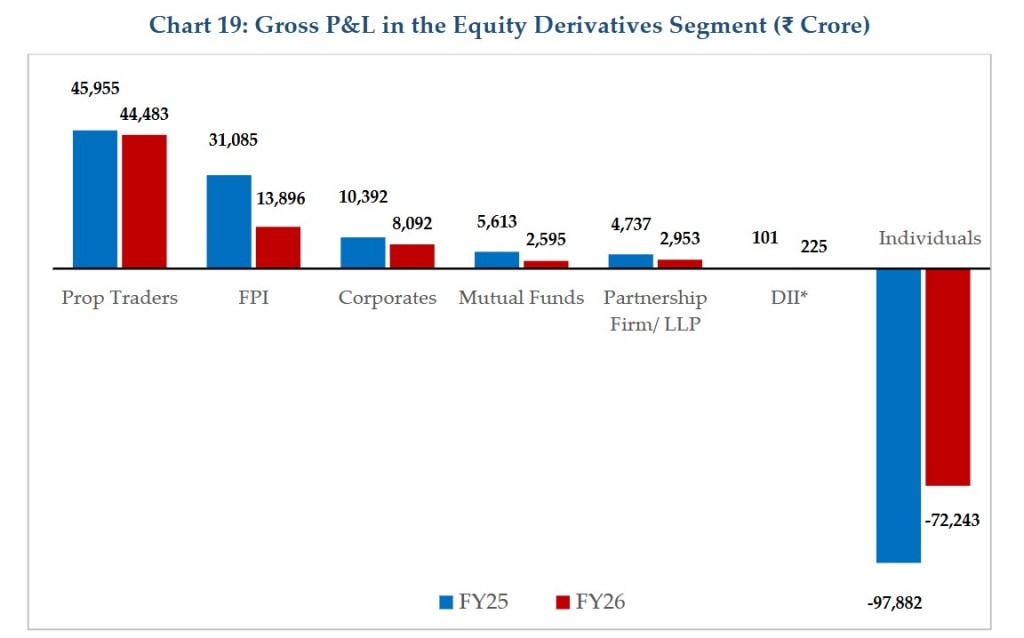
Source: Profitability of Individual Traders in the Equity Derivatives Segment (FY25-FY26), August 2026, SEBI
Ordinary folk like you and me are hugely disadvantaged. Even if we can figure out a profitable strategy, by the time we click the trade button, a computer has already beaten us to it.
What’s more, this is not a one-time phenomenon. People persist in trading derivatives despite repeated losses. And this isn’t unique to India.
So why do people do this?
There is no single answer, but several factors may work together. Options are a bit like lottery tickets. You could lose your entire capital, and the probability of winning is very low. But the potential rewards are high (compared to the amount invested).
Then there is overconfidence. If we make money today, we think it’s because we’re smart. If we lose tomorrow, we blame Donald Trump. This is also known as self-attribution bias.
Add to this the sunk-cost fallacy, which applies to gamblers as well. We want to recover our losses, and believe the next throw of the dice will be in our favour.
Further, the whole experience has been gamified. Trading apps are ridiculously easy to use, and relatively cheap. In options you don’t have to shell out the entire amount, just a part.
Add social media and FOMO to the mix. Some random joker posts screenshots with how much money he or she made, and you want to do the same.
Regardless of the reasons, SEBI’s data is alarming, especially when you examine the demographics.
Around 43% of individual derivatives traders were below 30 years of age, and three-fourths reported annual incomes below ₹5 lakhs. These people accounted for 53% of the losses. Around 78% of them had equity portfolios worth less than ₹1 lakh, while 35% had no underlying equity holdings at all. Traders with portfolios less than ₹1 lakh accounted for 51% of derivatives turnover, but 70% of aggregate losses.
So these are not rich people who can afford to lose money. Average loss per trader in FY26 was ₹1.17 lakhs, which is not insignificant compared to an income of ₹5 lakhs.
Interestingly, two-thirds of individual derivatives traders were not from India’s top 30 cities, and accounted for nearly half the turnover.
Market intermediaries and several academics are against any restrictions, arguing that derivatives provide liquidity, help in price discovery and hedging, and reduce overall costs for investors. This argument has some merit, but may be overstated.
SEBI has already tried to curb excessive speculation by raising costs, margins and contract sizes, as well as reducing the number of weekly expiries. Yet, the market remains concentrated in very short term options.
In India, 93% of individual derivatives traders trade only options. Moreover, 59% of index-options turnover comes from contracts expiring on the same day, 75% from contracts expiring within a day, and 97% within a week.
High volumes in short-dated options does not equate to deep, resilient liquidity. Nor does it translate into liquidity for longer-dated contracts or individual stocks.
We need to distinguish between speculation and genuine financial development. Simply generating more trading activity does not necessarily improve capital allocation, risk management or wealth creation.
Of course, there are no easy answers. Imposing further restrictions or costs could be counterproductive. Ultimately, we are fighting human behaviour, and that’s extraordinarily hard to change.
That’s why behavioural nudges might work better than blanket restrictions. Why not show traders their cumulative losses every time they log in? Or require brokers to prominently disclose how many of their customers lose money?
But more fundamentally, we need to question how we measure the success of our financial markets. Does it depend on capital raised and wealth created, or simply on trading activity?

Leave a Reply