For several years now, we have been hearing about an imminent capex revival and a manufacturing boom. Many of the essential ingredients seem to be in place.
Banks and corporates have healthy balance sheets, so money is available. Government capex is around 4% of GDP. Improving logistics and infrastructure, along with GST implementation have reduced transaction costs. The government has also chipped in with tax cuts.
Yet, the broad-based revival is still elusive.
There are some encouraging signs. MoSPI’s Annual Survey of Industries and Annual Survey of Unincorporated Sector Enterprises, suggested improvements in value added and capital formation, including in MSMEs.
On the flip side, the NSO’s annual survey of corporate capex found that investment intentions in its sample were broadly flat over three years. Further, overall capacity utilization remains stuck around 75%, and does not suggest an economy-wide capacity shortage.
So why hasn’t the boom arrived?
Covid, geopolitical conflicts and tariff uncertainty have disrupted supply chains, raised input costs and delayed investment decisions. India also faces inherent structural constraints that remain unresolved: land, labour, technology and critical inputs, bureaucratic red tape, water and power, etc. Doing business in India is still not easy!
But maybe, we are asking the wrong question?
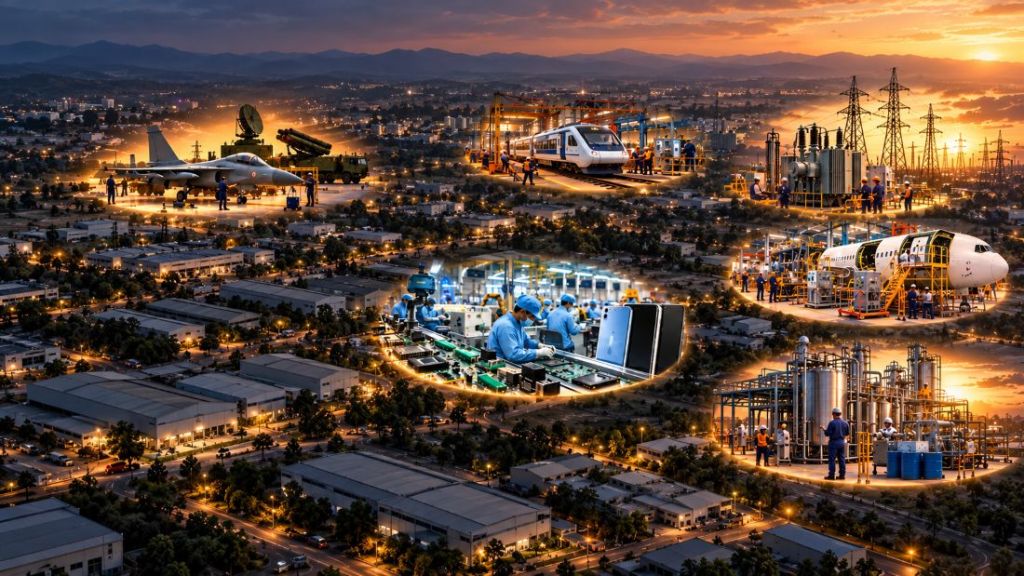
The boom might actually be hiding in silos or pockets.
The mistake could be treating manufacturing as one giant sector. It is not. For instance, a textile exporter, an auto components supplier and a transformer manufacturer serve very dissimilar markets and customers, and require different technologies, capabilities and inputs. Competitive forces also vary substantially.
National constraints and external problems may dampen the aggregate, but a few clusters or even individual companies could still flourish. A component manufacturer does not need the entire economy to become efficient. Its individual performance depends on a sufficiently attractive mix of opportunity, skills, costs and ability to execute.
And the evidence suggests this is what is actually happening, even as aggregate numbers disappoint.
Most visible is the PLI induced boost in electronics manufacturing. Despite concerns about low value addition, this is now spilling over from assembly; to components, materials and even machinery.
Defence is another example. India’s defence production reached reached ₹1.78 lakh crore in FY26, and exports crossed ₹38k crore, up 63% y-o-y. The private sector contributed 45% of the exports.
A very similar thing is happening in railways, aerospace, power and shipbuilding. Large government orders with clear preference for domestic suppliers has already had an impact. Supplier ecosystems are building up for a number of components and products, with a visible trickle down to smaller private companies.
All this is helping companies scale, build new capabilities, assimilate technologies, spread fixed costs and beef up domestic supply chains. As a result, many of these companies are now more competitive in export markets.
I’m not making this up! Just take a look at order books and revenue numbers for listed companies in these sectors. While current valuations may or may not sustain, there is definitely manufacturing traction and capacity creation.
The now mature auto component sector is moving from auto to defence, aerospace, and other industries. There are similar trends in select chemical and pharma companies, precision manufacturing and other engineering segments. The new trade deals will add more pockets of opportunity.
But we should not expect every factory or industry to benefit equally.
As I see it, the manufacturing boom will not show up as a rising tide that lifts all boats. It may be tiny ripples and waves that lift an industry or a cluster or few companies at a time. I wouldn’t be surprised if these small pockets eventually turn out to be much more consequential than initial numbers suggest.

Leave a Reply