We’ve grown up in a world where consumer spending meant FMCG. So when FMCG growth slows, we instinctively conclude that consumers are not spending.
But that’s a lazy conclusion.
The Household Consumption Expenditure Survey (HCES) 2023-24 provides a clue – the share of food has fallen sharply, while non-discretionary spending has risen. However, generic words like services and recreation don’t really tell us where the money is going.
So I decided to dig deeper and found some eye-popping data. We know what is happening, but often cannot comprehend the scale and impact. In fact, there are so many interesting stories that it lends itself to a series, rather than a single blog.
Let’s start with the “cricket economy”.
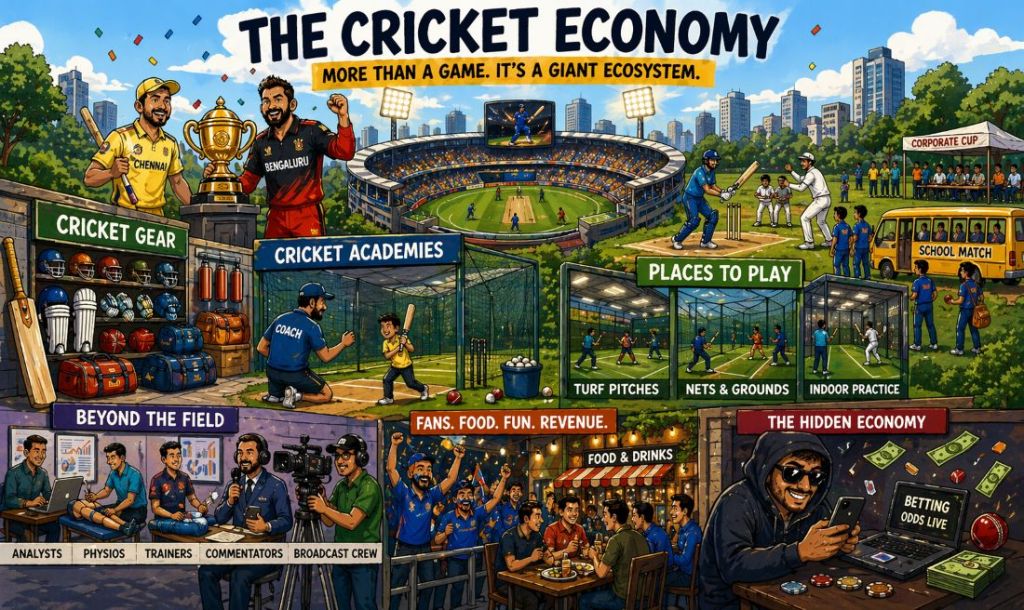
Recent news around the sale of Rajasthan Royals and Royal Challengers Bangalore at billion+ dollar valuations has been hard to miss. The combined valuation of the ten IPL teams could well be close to ₹150,000 crores.
BCCI alone will rake in an estimated ₹18,000 crores this year, with IPL the biggest contributor. Five year (23-27) IPL media rights were sold at a whopping ₹48,390 crores. Sponsorships of teams, advertising, celebrity endorsements together contributed around ₹17,000 crores in FY25. These numbers are well known.
But the IPL is only the tip of the iceberg.
Apart from international matches, we have the Ranji Trophy, Syed Mushtaq Ali Trophy, Vijay Hazare Trophy, etc. BCCI also conducts age-group matches (Under-23, U-21, U-19, U-17, U-15). Then there are the new state-level T20 leagues. And don’t forget the women’s matches – WPL, inter-zonal and age group matches. All told, we play more than 2000 “Official” matches every year.
On top of this, we have school and college matches, corporate and local tournaments. A rough estimate suggested there could be 300,000+ matches played annually across the country.
Each of these requires players, a pitch, support staff, umpires, coaches, cricket bats, balls, stumps, pads, gloves, and helmets. Little wonder that India is the largest producer (and exporter) of cricket gear.
Then there is the cricket coaching business. Apart from the hundred-odd large academies, there are probably around 20,000 small ones across every nook and corner of the country. Schools also provide coaching. At least 50,000 coaches are employed in all this. Conservatively, around half a million kids pay fees from a few thousand to a few lakhs for the privilege. While exam coaching makes the headlines, cricket coaching too is a ₹10,000+ crore business.
We need space to play, and this has encouraged many entrepreneurs to develop pitches, grounds, nets and even indoor practice areas. These businesses earn over ₹5,000 crores annually.
And I haven’t even got to ticket sales, in-stadia F&B, analysts, physios, trainers, TV crew, commentators and all the others in the ecosystem. Restaurants, hotels, and bars also rake in big money during IPL season or World Cups.
But the biggest part of the cricket economy is hidden – and that is betting. Fantasy games raked in upwards of ₹25,000 crores of user spend before the ban on real-money gaming. And much of that money is now going offshore, becoming part of the larger illegal gambling business. Cricket-related betting alone is estimated at ₹500,000 crores per year – 10-25% of which is retained by operators.
Much of this won’t show up neatly in consumption or GDP stats. But it offers a glimpse into how consumer spending has shifted – from things you consume, to things you experience, watch and participate in.
Cricket as it turns out, is no longer just a sport!

Leave a Reply