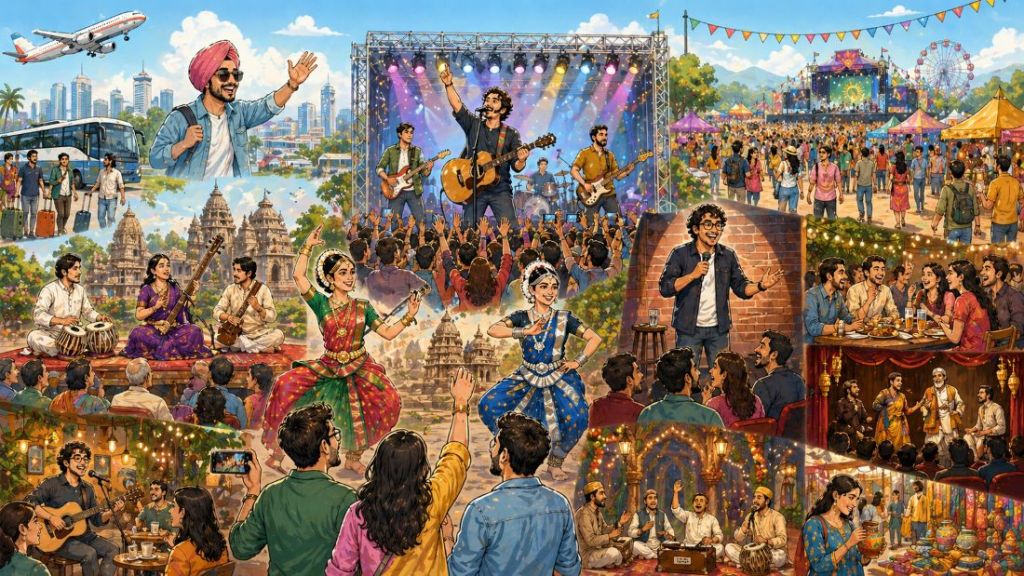
Continuing our series on shifting consumer spend in India – let’s move from cricket to another beneficiary of that trend: live entertainment.
This is a tough business in India. Multiple permissions, high taxes, unclear regulations, poor infrastructure and uncertain demand deterred many.
But that equation appears to be changing.
Post-COVID, consumers – especially younger ones – are prioritising experiences over things. It’s also a status thing; you can share videos on Instagram – “I was there”.
The upper-middle class is now larger, richer, and crucially, willing to pay. While films are increasingly watched at home, you cannot “experience” the thrill of a live show on a screen.
The huge success of the Coldplay and Diljit Dosanjh tours in 2024/2025 surprised everyone.
Diljit Dosanjh: 14 shows, 13 cities, 3.2+ lakh fans, ~₹220 crores in ticket sales, besides sponsorships and F&B revenues. But there’s more than only direct revenue. 38% of attendees travelled from other cities, boosting hotels, restaurants, airlines and railways. EY estimates suggest a 2.5x economic multiplier.
Coldplay: 5 concerts in Mumbai and Ahmedabad, 3.7 lakh tickets, one night in Ahmedabad broke all records – 130,000+ attendees. The same stadium has never seated as many cricket fans! Ticket revenues ~₹320 crores, total economic impact was double that.
The Sunburn Festival in Goa attracts 1 lakh+ attendees. NH7 Weekender has several shows, and the Pune event draws 20k people. Lollapalooza pulls in 60-70k. The North East has many multi-day festivals, such as Hornbill and Ziro, which combine music with dance, culture, craft and more to attract tourists.
At the other end of the spectrum sits classical music—less flashy, but pervasive.
Chennai’s December music season hosts ~2,000 Carnatic concerts in a month. The Sawai Gandharva Bhimsen Mahotsav runs for days and draws thousands daily. Apart from large events, there are thousands of smaller concerts, including intimate home baithaks.
These events typically keep ticket prices modest, relying more on sponsorships and F&B—a reminder that not all monetisation is ticket-driven.
Below all this, there is an exploding invisible layer.
Hundreds of music shows take place in colleges around the country, often free, but sponsor-funded. Then there are devotional concerts: Sufi music, temple concerts, ghazal nights and more.
Twenty years ago, Pune might have had one or two live gigs every week. Today, there are several every day. The same pattern is playing out across urban India. Live film music is played on the streets at all major festivals. Even DJs now attract large audiences.
This is only music. Major dance festivals like Konark, Mamallapuram, Modhera, Nishigandhi, Ellora/Ajanta and Khajuraho draw in thousands over multi-day events held at iconic temples.
Another new phenomenon is stand-up comedy. There are 2,000+ stand-up comics in India today, with top names filling large auditoriums with ease. There could be more than 20,000 shows every year, with total revenues exceeding ₹1,000 crores.
Theatre is seeing a revival as well. The multi-venue Nita Mukesh Ambani Cultural Centre reportedly hosts 1000+ shows every year. The Bharat Rang Mahotsav spanned 40 locations across India in early 2026, featuring 277 productions.
Pricing tells its own story.
A decade ago, tickets cost a few hundred rupees. Today, they run into the thousands—and premium seats into the tens of thousands. In fact, Coldplay tickets reportedly traded in the grey market at 10–20× face value, with some buyers paying upwards of ₹1 lakh.
Markets rarely lie about demand. More than ten million people were unable to get tickets.
Governments are slowly waking up. Regulations are easing up in some states, while GST has simplified taxation. However, the need for multiple local permissions and the lack of infrastructure (venues, parking, transportation, etc.) remain big constraints.
Some estimates peg the live events market at around ₹20,000 crores. That’s probably an under-estimate. Most of the smaller events earn from local sponsors and F&B, not from tickets. The overall economic impact is much higher, as an army of technicians, equipment providers, security personnel, videographers and others all benefit.
The direction, however, is unmistakable.
Live events in India are growing at high double-digit rates, and for a change, the constraint is not demand, but supply.

Leave a Reply