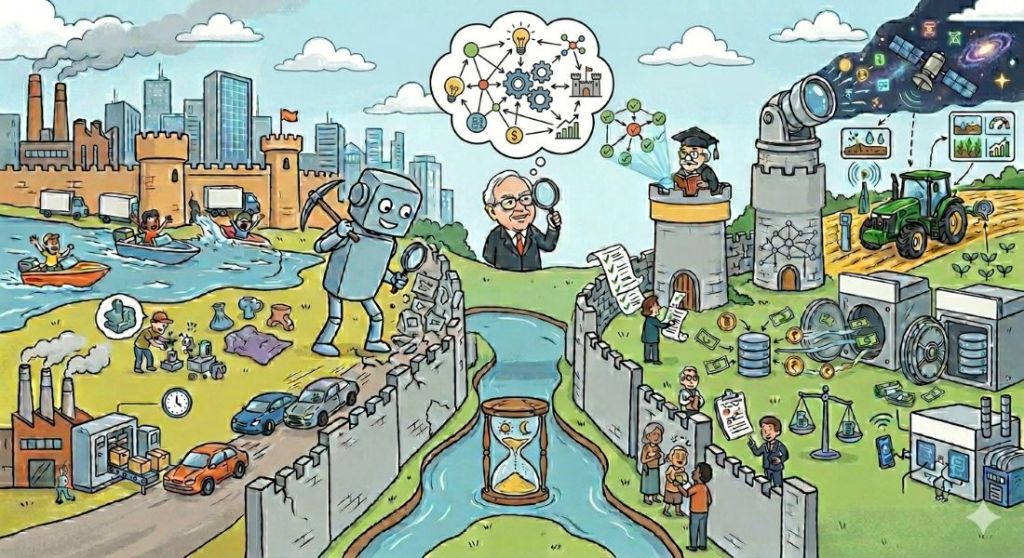
Warren Buffet and other gurus have long argued that the best businesses have “moats” or durable competitive advantages.
But moats too, have a shelf life, especially with technology disrupting every industry. In an earlier article, we saw how the powerful distribution advantages of large FMCG companies are being breached by D2C players leveraging e-commerce and digital advertising.
Some moats remain durable. Mineral producers, especially those with access to scarce, low-cost raw resources still enjoy structural advantages. A case in point is oil and gas. But these are rare exceptions.
Scale has been one of the most significant moats of the industrial era. It enabled lower fixed costs, better procurement and credit terms, distribution dominance and the vast cumulative learnings from experience.
But this is also being chipped away, as we saw in the case of FMCG. Modular manufacturing and 3D printing allow for distributed manufacturing closer to the customer. Digital procurement platforms give SMEs access to cheaper inputs. Even in auto, scale has not prevented Chinese EV companies from entering markets dominated by giant incumbents.
And the now ubiquitous AI is accelerating this shift, threatening moats in SaaS, software, professional and creative services, consumer products (via price discovery) and even manufacturing.
Incumbents however, are not sitting idle. And their most potent weapon is “data”.
Modern giants like Meta and Google are built on vast, incomparable datasets. Zomato and Swiggy don’t just have restaurant data, but valuable info about how customers eat. In the AI age, the best models will be those trained on high-quality data.
LexisNexis for instance, has built AI driven workflows on top of 200 billion+ proprietary legal documents, offering verifiable citations that reduce hallucinations—something general-purpose LLMs cannot match. Lawyers don’t want to be citing bad data. Thomson Reuters has also taken a similar approach.
Banks like SBI and HDFC not only have large customer bases, but own decades of credit and behaviour data. Insurance companies with long claims history can price risk more accurately.
Large capital goods manufacturers (like John Deere and Siemens) use sensor data from installed equipment to prevent failures and optimize performance. Their vast installed base provides a data advantage start-ups cannot match. John Deere even leverages proprietary satellite data to help farmers save on fertilizers and other inputs.
Many of these companies are pivoting to a subscription model, with clients paying for uptime or usage. Large balance sheets allow them to fund this Capex, which smaller companies cannot. The data is continuously enriched (including by your usage) making it difficult to switch.
Moats built around regulatory barriers, customer relationships and trust, can also endure. We might borrow from a fintech, but may not want to deposit our savings with them. In mission-critical components, decades of reliability matter, and OEMs are slow to switch suppliers.
So all is not hopeless. Just as start-ups can use AI/tech to disrupt, smart and agile incumbents can use the same tools to fend them off, and even widen the moat.
Moats are not disappearing – they are evolving continuously. However, their lifespan appears to be shrinking.
As an investor, the study of competitive advantage occupies a lot of my time. Would love to hear your views on companies building new moats or successfully defending old ones. Feel free to start a discussion below.

Leave a Reply