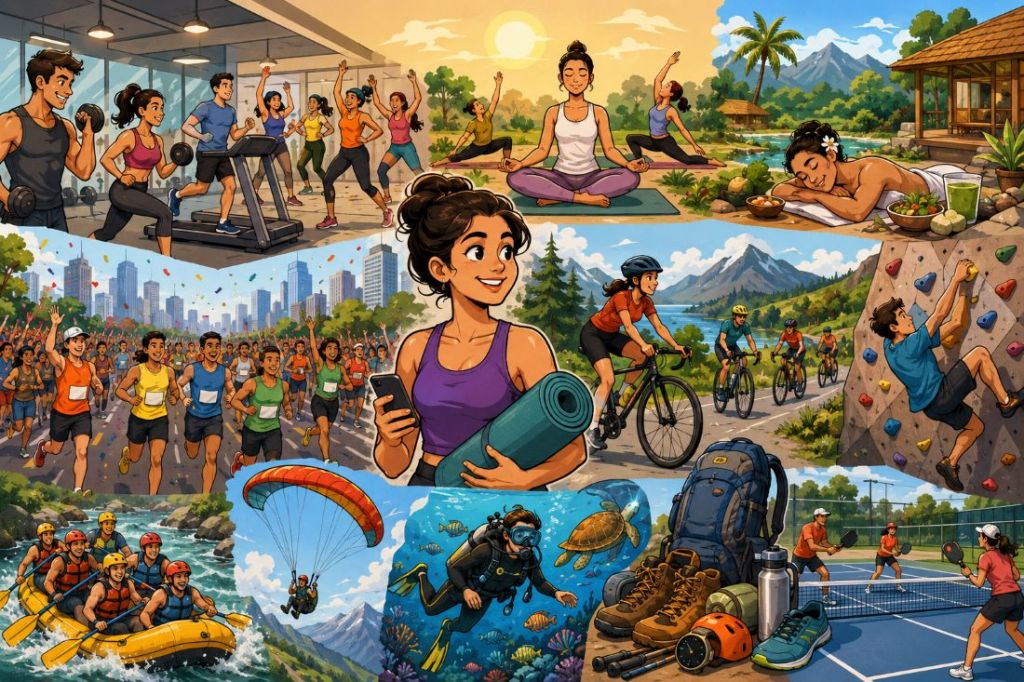
India’s Fitness Economy Heads Outdoors
In the last two episodes, we looked at the cricket economy and live events. Today, we turn to another corner of the experience-led consumer economy: fitness.
For a long time, fitness in India meant two things: gyms and yoga. Both are still going strong. What’s changed is how people engage with them.
Gyms are quietly reinventing themselves. The old image—rows of machines, a few mirrors, and a lot of grunting – has given way to something far more layered. Today’s gyms are multi-disciplinary: Yoga, Pilates, Zumba, HIIT, functional and personal training.
Workouts today are less solitary and more social. This has helped gyms reduce churn and charge higher prices. India now has roughly 65,000 gyms, and more than 20% are premium or boutique formats.
Yoga, meanwhile, has scaled in a very Indian way – mass participation alongside premiumisation. On International Yoga Day 2026, around 260 million Indians rolled out a mat. Not all of them rolled it out the next morning, but estimates suggest that > 100 million of us practice regularly – and are increasingly using apps; and buying mats and yoga outfits.
At the same time, yoga is being packaged and sold as an experience. Studios, fancy “shalas” and increasingly, retreats in scenic locations that combine asanas with massages, Ayurveda, and detox menus. It’s not just “practice” but an “experience”.
Beyond gyms and yoga, things get more interesting.
Running has seen a remarkable surge, especially long-distance running. India now has roughly 2.5 million registered runners and over 1,500 events annually. In 2004, the first Mumbai Marathon had about 700 full marathoners. In 2026, that number was 14,000 of a total participation base of 69,000.
Today’s marathons feel less like races and more like travelling carnivals – with bibs. The craze has spread well beyond metros into tier-2 cities.
While participation fees are modest, the economic impact is anything but. The Tata Mumbai Marathon 2026 generated ₹10-15 crores in entry fees, but the overall economic impact was estimated at over ₹500 crores. Sponsorships, charity collections, advertising, hotels, food—an entire ecosystem rests on the runners.
The spending doesn’t stop at the finish line. Runners invest in premium shoes, apparel, nutrition, coaching – and increasingly, identity. For many, the real finish line is Instagram.
Cycling is another fast-growing recreation. Over 90% of cycles sold in India are still for basic commuting, but the remaining ~10% (a million bikes a year) are “lifestyle” purchases. These aren’t cheap. Prices start around ₹10,000 and can run into several lakhs.
There are an estimated 5 million weekend cyclists and over half a million serious endurance or mountain biking enthusiasts. The bike, however, is just the beginning. Helmets, apparel, GPS devices, nutrition, and eventually, cycling trips in Kutch, Ladakh or the Nilgiris. Naturally, all this fuels hundreds of small businesses.
Adventure sports are another high-growth area, estimated at $15 billion annually. Within this, trekking dominates with around a 30% share.
Treks have long been popular, but participation has quietly exploded. There are now an estimated 1.5 million serious trekkers, and casual ones, many multiples of that. The Himalayas remain the big draw, followed by the Sahyadris.
With this comes an entire gear economy—tents, sleeping bags, backpacks, shoes, apparel, GPS watches and trekking poles.
River rafting is another major category, with Rishikesh as the nerve centre, attracting over half a million rafters annually. Newer hubs are emerging across Himachal, Maharashtra, Karnataka, and the Northeast.
There are a few hundred licensed operators and many more in the shadow economy. Unlike trekking, most equipment here is owned by operators, so the direct retail spend is smaller—but the broader economic footprint is significant, with hotels, campsites, transport operators all raking it in.
Even something as niche as para-gliding now has close to a lakh participants every year, with Bir Billing in Himachal as the epicentre. Scuba diving draws similar numbers, and snorkeling 3-5x of that.
Pickleball is considered the fastest-growing recreational sport, with several hundred courts mushrooming across the country in just a few years. My housing society now has one!
Have you heard of bouldering? I hadn’t, till my daughter educated me. Add to the list endurance sports, skiing, bungee jumping, ziplining, canyoning, caving and god-knows what else. The young seek new experiences, and there is no dearth of options today.
I don’t know if you’ve ever visited a Decathlon store. It’s eye-opening – I’d no idea that there were so many types of shoes and esoteric sports equipment. They now have >130 stores in India, and revenues of around ₹5,000 crores.
The fitness economy in India is its infancy. Most of these activities are still on the fringe, or niche. But the bulge in young people, along with rising health awareness and incomes will fuel growth. As will Instagram!

Leave a Reply