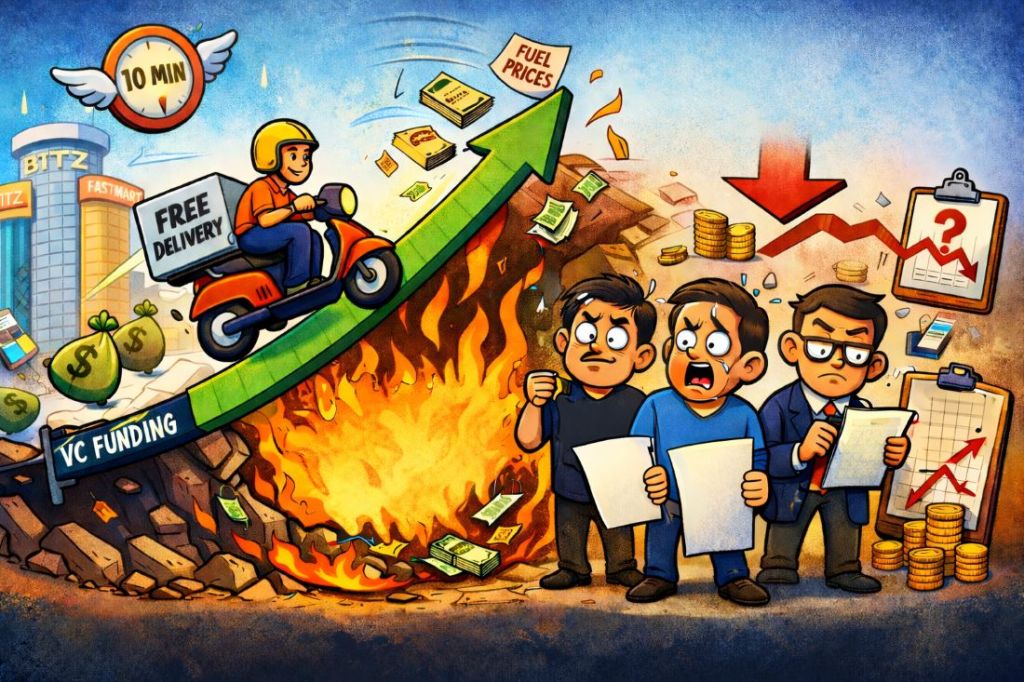
Quick commerce redefined Indian retail in 2025. Blinkit, Instamart and Zepto delivered explosive growth, pushing incumbents like Flipkart and Amazon to (reluctantly?) launch rival formats.
Blinkit, Instamart and Zepto all doubled revenues in FY25, with momentum continuing through 2025. In a single quarter (Q2FY26), Blinkit delivered a net order value of ₹11,679 crores, up 137% yoy.
India’s e-commerce market is now at ₹15–18 trillion, growing at nearly 20% a year, with even non-quick platforms posting strong double-digit growth. Listed players — Eternal, Swiggy, Meesho and Nykaa — together are valued at ₹532,000 crores. Zepto is eyeing a ₹70,000+ crore valuation at listing. Amazon and Flipkart are worth far more.
Most of these businesses still don’t make money. The strategy is to attract customers via subsidies, and hope they stick around and spend more. Valuations suggest continued rapid growth, improved execution and a visible path to eventual profitability.
The underlying belief — or hope — is that scale efficiencies and lower customer acquisition costs will eventually deliver profits. This is the core pitch from company managements and spreadsheet specialists.
However, this entire story sits on a single assumption – that delivery costs will not rise substantially (or will not exceed product inflation). Today, for all e-commerce companies (that deal in physical goods), delivery is the single largest variable cost.
Social media loves stories about foreigners in India being amazed by the quick delivery of random things, at no (or low) cost. While part of this is subsidised by losses (read investor money), it is enabled by the fundamentally low cost of delivery workers – lower than in most parts of the world.
Delivery partners typically earn around ₹25k-45k per month (if they work full-time). However, fuel costs take away 25-35% and the cost of financing and maintaining the vehicle also fall on the delivery agent. As a result, net earnings are much lower, often barely above minimum wage.
Two recent events suggest that delivery costs will rise in the short to medium term. One is the new labour codes, and the second is the recent large-scale labour action by gig-workers. For the first time, delivery workers across platforms went on strike at the same time, nationwide – and on Christmas Day and New Year’s Eve, two of the biggest days for e-commerce players. The timing, clearly, was not accidental.
The labour codes might take a while to implement, but the writing is on the wall. Whether through government pressure, or labour activism increasingly backed by political forces, compensation will increase.
Delivery costs can vary, but average around ₹40-70 per order. If companies now have to provide insurance, social security, fairer compensation that accounts for petrol usage or distance covered – costs could rise by ₹10-20 per delivery. This is substantial, given current profitability – or the lack of it.
Path to profitability projections may need revision, unless companies bite the bullet and start charging realistic amounts for delivery. Sooner or later, this must happen.
While this initially appears as negative for the industry, the experience of China throws up some interesting insights. When they transitioned from free to paid delivery (circa 2016-2022), some categories saw reduced growth, but the overall industry continued to grow. Fewer freebies also reduced churn.
Essentially, companies with a higher average order value (AOV) are better able to pass on delivery costs. If the order size is ₹1,000, and delivery costs ₹50 – the customer will pay 5% more. But on an order size of ₹50, the price will double. Companies with greater density (shorter trips and order batching) will also benefit.
Consumers will crib loudly at first, but then migrate to larger order sizes to minimise effective delivery costs. Impulse buying of single, low-value items will drop, and customers may club several purchases into one. This might actually benefit e-commerce companies as uneconomic orders reduce.
Of course, not all players will increase delivery charges at the same time. The financially stronger companies might continue to subsidise customers to squeeze out the weak.
Ultimately, scale alone won’t be enough. Companies with dense networks, efficient distance economics, and higher AOVs will win, while others are squeezed out. Consolidation is inevitable as freebies quietly disappear.

Leave a comment