Indian businesses and start-ups are often criticized for serving only richer, urban customers. But this is lazy criticism. Economic forces push businesses to solve problems that are more likely to make money. That’s just the way markets work.
So when one finds a start-up working in rural India, using technology to change behaviours and provide economic returns for participants – and doing it at scale – it is truly unusual, and worth paying attention to.
One such start-up is BiofuelCircle.
First, the problem.
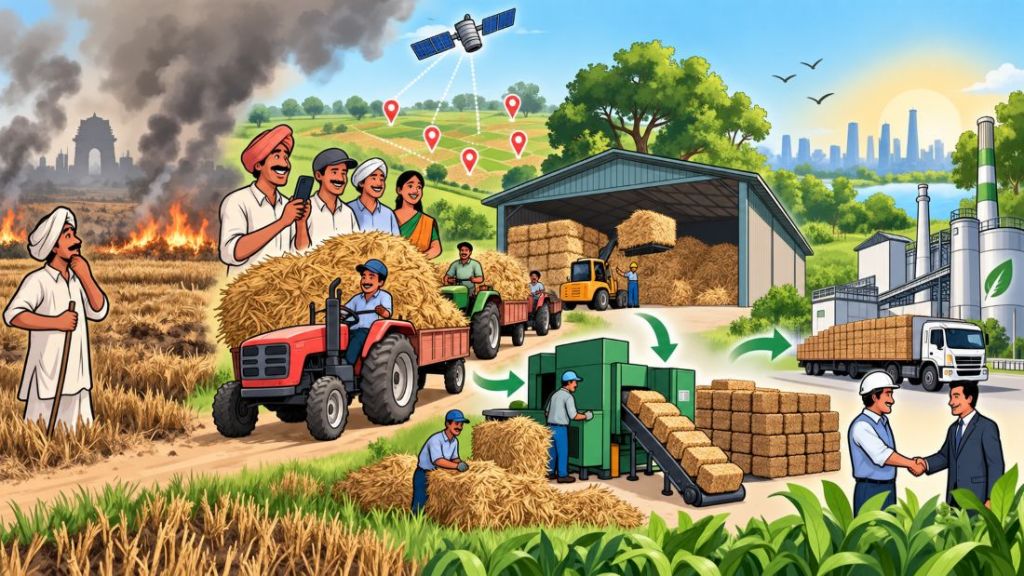
India generates approximately 700 million tons of crop residue annually. Much of it is used as fodder, but around 235 million tons is thrown away, or burnt; since it costs money to clear, collect and process. The resulting “stubble burning” makes large parts of North India (including Delhi) toxic in winter. This repeats every year, sparking respiratory diseases, media outrage and political blame games. But nobody provides solutions.
Enter BiofuelCircle.
In 2020, they set out to create a supply chain for agri-residues. The hypothesis was simple: Farmers would be happy to monetize this waste, and industries happy to buy the calorie-rich material. The missing piece was a mechanism to connect the two.
The reality turned out to be much, much more complicated.
And this is where the philosophy of the team/founders came into play. At the outset, they knew their understanding of the problem was limited, and the business model would have to evolve as they went deeper. Technology was a must to democratize access, but needed to adapt to solve unanticipated problems.
Let’s take the challenges one by one.
The first problem was aggregation. Farms are small and residue per farm is too little to interest a buyer. To gain viable volumes, BiofuelCircle aggregates waste across roughly 2500 farmers (or 5000 acres). To reach out and convince farmers or farmer producer organisations (FPOs), they combined ground presence with smart use of available communication technology (like Whatsapp).
But how are you going to collect this waste? There is a very short window between successive crops, and residue must be collected over a large area within days. Small farms don’t have enough tractors or labour to do this.
BiofuelCircle responded with a model resembling an e-commerce delivery network. Tractor owners and drivers – whose assets are normally idle post-harvest, provide the tractors and labour. They are given a schedule and a GIS location so they know where to go, and when. Route planning uses satellite imagery, GIS, and harvest data.
They get paid based on distance covered, and amount transported. IoT technology tracks the fleet and weigh-bridges measure quantity. BiofuelCircle even provides diesel, and pays money the same day. Hugely important for building trust. In effect, BiofuelCircle created a rural gig-economy network around otherwise idle labour and assets.
But where does this material go? How is it stored? Waste is collected in short spurts, but industrial user demand is year-long. So they needed to build storage infrastructure.
This was a crucial turning point. What began as an asset-light model couldn’t remain one. BiofuelCircle invested roughly ₹300 crore in around 100 biomass banks, which now forms the backbone of its supply chain.
Then came processing. Agri-residue is bulky, and transportation costs high – so waste has to be compacted or briquetted. Rather than build all the plants itself, BiofuelCircle works with rural entrepreneurs willing to invest in them.
It provides technology, sources equipment, trains the entrepreneurs, provides raw material and guarantees offtake. In effect, it de-risks the business for entrepreneurs, much like Pespi or McDonalds get farmers to grow potatoes for them.
Now, let’s look at the buyers. Several large industries want feedstock of consistent composition/quality at predictable prices. The biomass banks concentrated local sourcing, and ensured quality and availability throughout the year. Their trading platform provides price visibility, and functions like a stock exchange – providing considerable flexibility to buyers.
So what’s the net result?
Close to hundred biomass banks. 1800 villages covered, more than 70,000 farmers participated last year. 2000+ tractor owners/drivers earned additional out-of-season incomes of ₹1-4 lakhs per year. Around 15 rural entrepreneurs earn a few crores annually. Last year, 800k tonnes of biomass moved/traded, and will go up to 2 million tonnes this year.
Admittedly, this makes only a small dent in India’s enormous agri-residue problem. But the company is only six years old, their solution is designed to be scalable, and the ambitious team is aware that many hurdles still need to be overcome.
The beauty of the model is that everybody has an economic incentive – no subsidies involved! Farmers earn from waste, tractor owners and drivers earn during the off-season, entrepreneurs are created, and industrial consumers get reliable, consistent supply.
This is what makes BiofuelCircle unique. It is using technology not to build another app for urban consumers, but to make a messy, fragmented physical supply chain economically viable at scale.
Let’s hope the company and its investors end up making tons of money – we need more such role-models.
I’d love to cover more such innovative start-ups. If you know of any, do reach out.

Leave a Reply