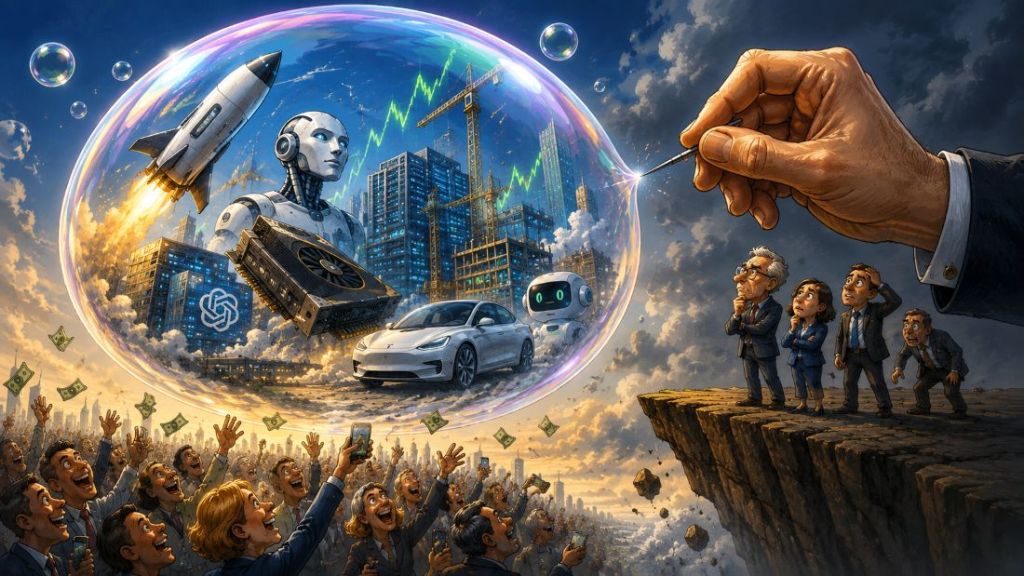
The most talked-about event in recent days has been the SpaceX listing. Every day, there are stories about Elon Musk’s net worth, and how he made more money in a single day than Warren Buffett made in a lifetime.
The SpaceX frenzy is not an isolated event but the latest episode in the unparalleled boom in AI and tech stocks.
The numbers are staggering:
- The nine largest US stocks are all tech/AI-driven, and have a combined market cap of ~$30 trillion. That is almost as much as the US GDP in 2025.
- The market cap of tech/AI stocks exceeds 20% of global market cap.
- South Korean and Taiwan indices have soared on the back of huge gains by a few stocks like Samsung and TSMC.
- Capex spending by a handful of large AI players will touch $700 billion in 2026.
- Unlisted companies like OpenAI and Anthropic are valued at close to $1 trillion.
- The US accounts for ~50% of global market cap, but only a fourth of global GDP. By some accounts, more than 75% of fresh inflows go to US markets.
And all this has happened amidst wars and geopolitical turbulence.
All economies face huge inflationary and supply-side pressures that threaten economic growth. But the AI juggernaut simply rolls on. Even the threat of higher interest rates doesn’t seem to dissuade investors.
Across the world, and even in India, FOMO is becoming more acute. In the past two weeks, I’ve been advised (more than once) to open a GIFT city account, and several random people have asked me whether they should invest abroad.
Meanwhile, market commentators tell us that “this time it’s different”.
AI will change the world (it’s already happening). Most of the largest investors in AI infra are already profitable companies, and AI companies already have millions of customers. Hence, this is not comparable to the dotcom boom, where companies had little or no revenue.
To be fair, the Bulls do have a strong narrative. And the money (including retail money) is buying into this narrative.
But is this really different from past “bubbles”?
Most similar episodes, like the Internet boom of the late 1990s, the railroad boom of the 1840s, and the electrification boom of the 1920s, all promised to change the world. And they did!
However, in all cases, market expectations were too rosy (or too early). Not all companies survived, and even the winners could not sustain irrational valuations.
Infosys shares peaked in March 2000 at the height of the IT boom, with P/E valuations in triple digits. It then took around a decade to recover this price, despite 30%+ growth through that period.
Today’s technology revolution may well be as transformative as the bulls suggest. The problem is really one of timeframes – how far ahead are you willing to discount the future?
Elon Musk might well put people on Mars. The question is, when? And whether valuations can sustain that long?
Strangely enough, most investors know this. Today, bubble risks are openly discussed on social media. Everyone knows the dotcom history, and skepticism is widespread.
But FOMO is extraordinarily hard to fight, especially in this age where every punter can instantly broadcast their investing success to the world.
When will the madness end? Frankly, I have no idea. Herd mentality and irrationality can persist far longer than we think.
Will it end? Surely.
But we all believe that it will not end today. We also believe that we will know when the party ends. And that some “greater fool” will always exist to buy from us.
All I can say is “best of luck”.

Leave a comment