The “Efficient Market Hypothesis” (EMH) became hugely popular in the seventies and influenced market thinking for a long time (it still does). Essentially, it postulates that markets are efficient, and prices reflect all available information at any given time, so outperformance can only be achieved by taking more risk.
EMH gained popularity because it was simple, seemed consistent with the evidence, and arrived just as technology was making information widely available. It eventually became the foundation for risk models, options pricing and passive investing.
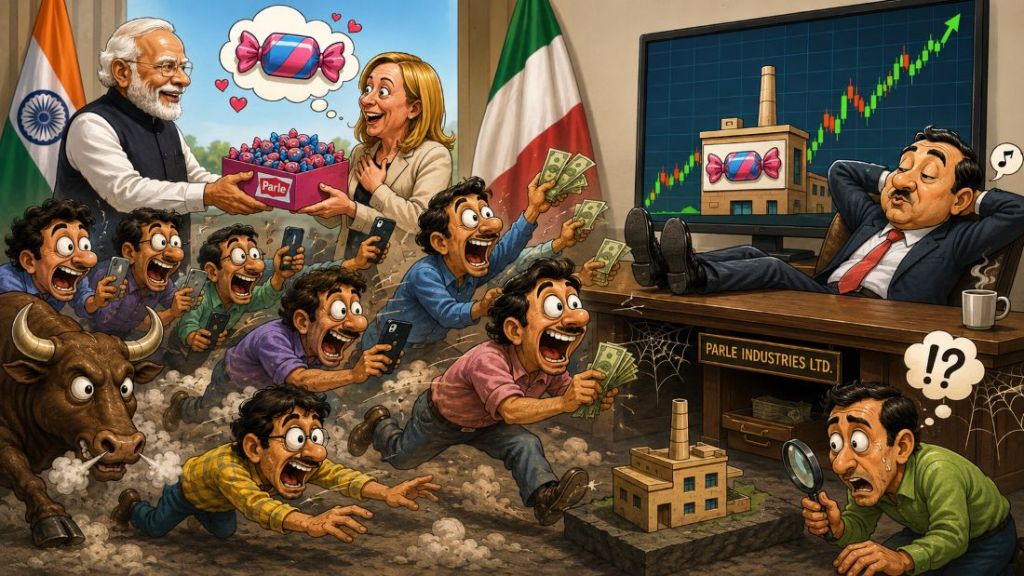
A central pillar of EMH is the belief that investors behave rationally. Behavioural finance emerged in part as a challenge to this idea, arguing that emotions, biases and irrationality often drive investment decisions. The ongoing saga of Melody toffees and Parle Industries only reinforces the point.
On the 20th of May, Prime Minister Narendra Modi gifted his Italian counterpart Giorgia Meloni, some Melody toffees. This tongue-in-cheek gift went viral and sparked a storm of online chatter.
This boosted sales of Melody toffees in India, with many retailers running out of stock. The manufacturer Parle Products Pvt. Ltd. was thrilled and splurged on full-page ads in national media, thanking the PM.
And on the stock market, Parle Industries’ shares surged. In just ten trading days, the stock has jumped from ₹5 to ₹8.09, a gain of 62%, hitting circuit breakers every day.
It appears that investors also found a way to benefit from the Melody craze.
But wait a minute – this company has nothing to do with Melody or Parle Products!
Parle Industries apparently has businesses in real estate, trading and investments. In 7 of the last 10 years, revenues haven’t crossed ₹1 crore. The ownership pattern is murky, with no “official” promoters.
Despite these facts being widely available and repeated warnings from market observers, the stock remains locked at the upper circuit as I write this (3rd June) – for the tenth consecutive trading day.
So, why are people buying?
Is it madness? FOMO? Momentum triggers? A desire to lose money?
Whatever the explanation, irrational episodes like this occur more frequently than we think. And this behavior provides fertile ground for manipulators.
Most scams rely on a simple pump-and-dump strategy. Operators accumulate an illiquid stock, engineer a rally and amplify the story online. When momentum signals take over, and greedy investors jump in, the operators sell and walk away with huge profits.
SEBI recently took action against a number of such crooks, and has tightened regulations for influencers. But ever since I’ve been investing (now more than 35 years), there has been no shortage of scams.
Regulatory action can only do so much. In the end, it’s greedy investors who create the enabling environment for crooks.
And as the curious case of Melody and Parle Industries shows, greed invariably trumps rationality and the EMH.

Leave a Reply