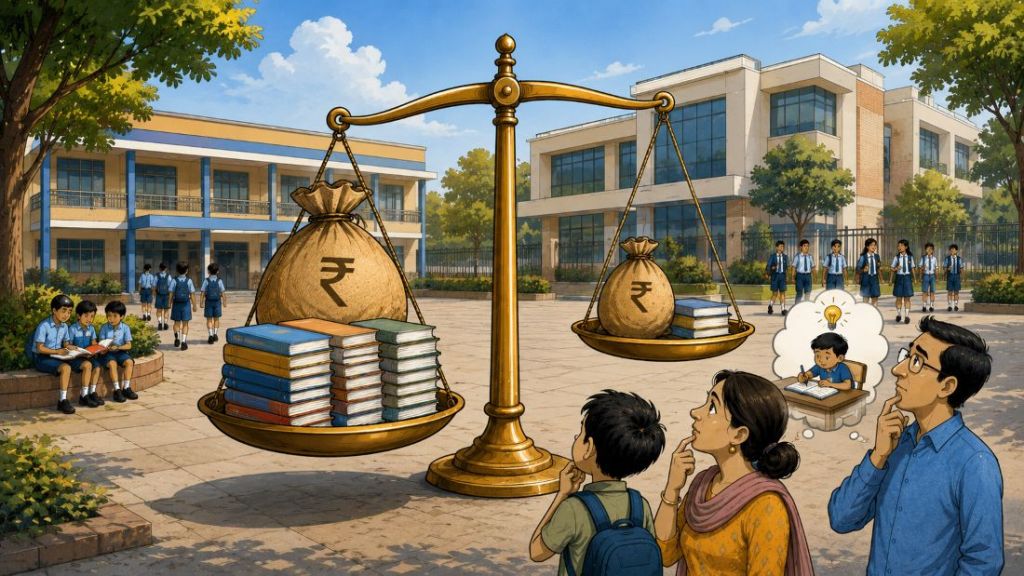
Fees Are Visible. Learning Isn’t.
The Punjab government recently proposed a 5% cap on annual fee increases by private schools. Apparently, this is intended to curb “profiteering” and improve transparency. According to the news report, Mr. Harjot Singh Bains, the Education Minister of Punjab, said that education is a noble public good, not a commercial enterprise.
The parents of Punjab’s 2.7 million students in private schools are naturally happy, as several unscrupulous school managements have “arbitrarily” hiked school fees.
And naturally, schools are unhappy. They argue that inflation is high, and they will not be able to provide adequate salary increases for teachers or improve teaching aids.
This is a common debate, and many states have taken similar actions. But is education only about fees and spending?
Government schools, on average, pay teachers 2-5x more than private schools. In terms of overall expenditure per student, government schools spend more than twice the average private school fees. But this does not appear to impact outcomes.
According to the Annual Status of Education Report (ASER) 2024, only 45% of Class 5 students in government schools can read a Class 2 text, compared with 59% of private school students. Detractors argue that richer and more educated parents send their kids mainly to private schools, so the outperformance needs to be adjusted for that.
But given the per-student costs, the efficacy of private schools per Rupee spent is higher. This does suggest there is a case for private schools charging enough to afford better teachers.
However, restricting this debate to costs or fees obscures the deeper question – one of outcomes. More spending doesn’t necessarily result in better learning. There are issues around accountability, bureaucratic systems, language of instruction and rigid syllabi. Most importantly, we do not systematically measure results, nor do we make such information public.
Both school systems deliver poor outcomes. Our education system is evaluated on input, not output. Inputs are easier to measure – so we measure teacher qualifications, buildings, toilets, spending, etc., but not what matters – children’s learning.
And competition does not seem to have solved the problem. This is because parents cannot assess quality and don’t know whether their kids will be better off at one school or another.
A fee cap may be politically beneficial and help affordability. However, it does not improve reading or math skills, accountability, or employment outcomes.
Unfortunately, discussions on India’s education crisis often degenerate into a battle between expensive private schools and free government schools.
But that may be asking the wrong question.
Fees are not the real issue – but why, after decades of rising public and private spending, do children still struggle with reading and addition? And until we try to answer that question, the arguments about fees only distract us from the real issues.
Maybe that’s why governments like fee caps. It creates the appearance of action, while doing nothing to address the real problems.
Parents know when fees rise by 10%. But they don’t know whether learning improved by 10%. And as long as we fixate on fees and costs rather than education outcomes, nothing will change.

Leave a comment