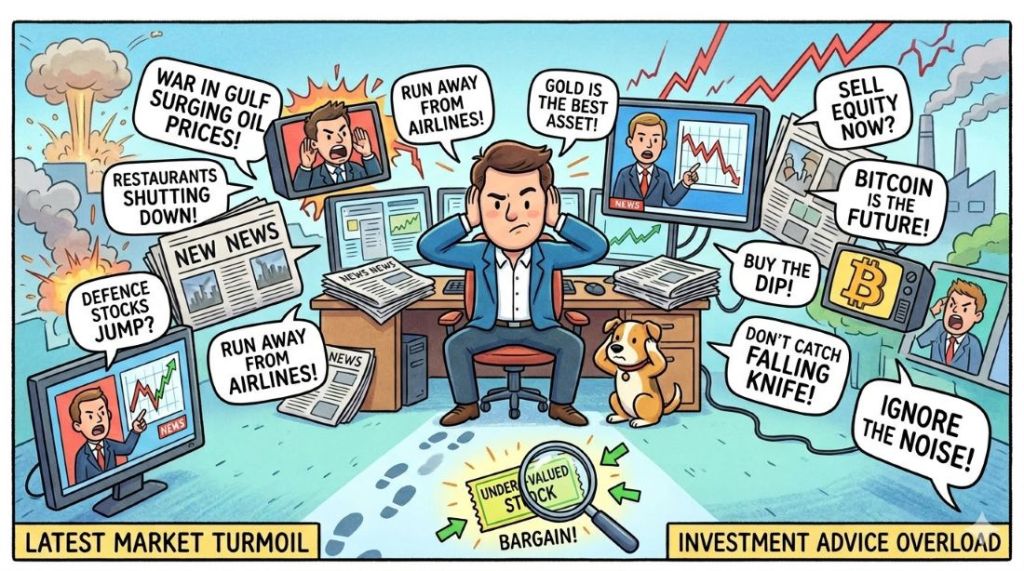
One of the hardest lessons (for me) as an investor has been how to ignore unsolicited investment advice, especially at chaotic times like this.
As the US-Israel vs Iran war grinds its way into Week 3, the world is facing an unprecedented energy shock.
Large supplies of oil, gas, aluminium, and fertilisers cannot move because ships are not safe in the Gulf of Hormuz. Downstream industries will be starved of petrochemicals. Airlines cannot fly over the region or use hubs like Dubai, Doha and Abu Dhabi. Freight costs worldwide are surging. And this is just a partial list.
In India too, an LPG crisis has forced restaurants, canteens, and cloud kitchens to shut down. Tile makers in Morbi cannot get gas, nor can several metal and manufacturing industries. Chemicals and pharma companies worry about raw material availability. Exporters to the Middle East are hurting.
Amidst this turmoil, all types of investment advice are being freely offered.
- Defence and upstream energy stocks are obvious plays, though skeptics believe recent price jumps have already discounted the future.
- Conversely, many recommend running away from badly affected sectors like airlines, downstream chemicals and tiles; while an equal number argue that the war will eventually end.
- One bunch of experts say that gold is the best asset in times of war. Another group thinks that selling inflated gold and buying beaten-down equity is a better strategy. And of course, don’t forget the bitcoin enthusiasts.
- The cautious types suggest buying treasuries or holding cash.
- There is a faction that says “Don’t try to catch a falling knife”. But on the next channel, an equally famous analyst is quoting, “Buy when there is blood on the streets.”
It’s hard not to be affected by this circus. One day, an extremely articulate fund manager convinces you to adopt a certain strategy. The next day, an even more persuasive influencer argues the opposite.
In the end, we only get more confused and start doubting our own judgment.
So, how then to navigate so much chaos in the world?
The reason we buy stocks is that we believe (or hope) their prices will go up substantially. There are many reasons why stock prices rise – it could be events (like wars and tariffs), policy changes, Trump’s posts, hot FII money, some industry or company-specific trigger, and more.
None of these is predictable. Nor really suitable for us individual investors, especially if we want to sleep easy.
The one consistent cause for stock price appreciation is the existence of under-valuation. Even after assessing growth, cycles, moat, industry prospects and all the other nice stuff, the final call is on the price we pay.
If a business is priced significantly lower (factor of safety) than its intrinsic value, there is a high probability of making “good” returns. This is what the investment masters have proven and written about, but we tend to forget – especially when there is too much noise.
Trumps, wars, elections, pandemics, financial panics, and many other unanticipated events will keep happening.
And distracting us from what’s really important!
Identify a decent company, wait till you get a true bargain, and then go for it.
I know it sounds a lot simpler than it is. You’re also right that there is nothing new or original in this approach. However, the difficulty is not conceptual, but one of self-discipline. Even the most seasoned investors get distracted by the noise.
Maybe we’d be better off spending our time looking for valuation anomalies rather than scrolling the news.

Leave a comment