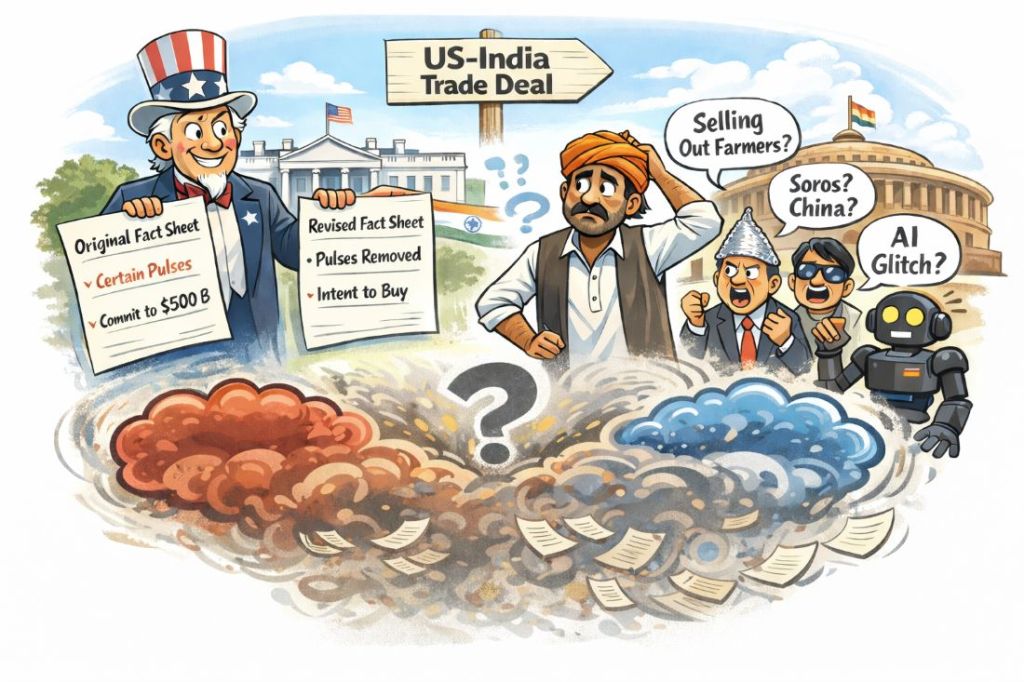
As expected, the US-India trade deal has hogged headlines. The opposition is crying foul, the usual critics of everything have rediscovered their vocal chords, and social media has done what it does best – declared an apocalypse.
Amidst all the noise and hot air, the US government bowled an unplayable googly that was later ruled a no-ball.
In a fact sheet published on February 9th, while listing agricultural items on which India would cut duties, the US government casually slipped in two explosive words: “certain pulses.”
Not which pulses. Not how many. Just… pulses. Certain ones. The rest is up to interpretation, yours or mine.
Naturally, this set off a furore. The government was accused of “selling the country”, “selling the blood and sweat of farmers” and more. One of the most graphic and theatrical quotes came from Randeep Singh Surjewala, who apparently said, “A blow has been delivered to the stomachs of India’s 720 million farmers.”
A somnambulant opposition finally had an issue. Pulses differ from the other commodities in the framework agreement because they affect a large number of Indian farmers. They take up almost a fifth of our farmland, but contribute only around 5% of agricultural output (by value) – making it politically sensitive. Even though we don’t grow enough and already import large quantities, this gave the opposition a good handle.
The government insisted that pulses were not included in the deal. Detractors, however, had more faith in White House PDFs than in Indian ministers, and treated the fact sheet as the ultimate truth.
Two days later, on February 11, a revised fact sheet quietly appeared on the White House website. Pulses were gone. No explanation. No apology. Just a fresh PDF and a new reality.
But wait — there was more.
The Feb 9th fact sheet said that India “committed” to buy $500 b worth of US goods, including agricultural products. But on Feb 11th, the commitment was downgraded to intention, and agriculture was nowhere to be seen.
Similarly for digital taxes. From India “will remove” its digital services taxes to “will negotiate” bilateral digital trade rules, we went from promise of action to promise of more talk.
Even social media — usually confident about everything — is now confused. This has provided ample masala for conspiracy theories of every flavour and heat level.
Does Trump enjoy disrupting India’s parliament?
Were they trying to fool the US public?
Was it a pressure tactic?
A conspiracy funded by George Soros?
Or maybe this is just artificial intelligence hallucinating?
Or for completeness – hackers from China?
Who knows?
To quote Bob Dylan… “the answer my friend, is blowing in the wind”.
…or maybe, in the next fact sheet!

Leave a comment