When “wages” finally mean wages — and everyone gets counted
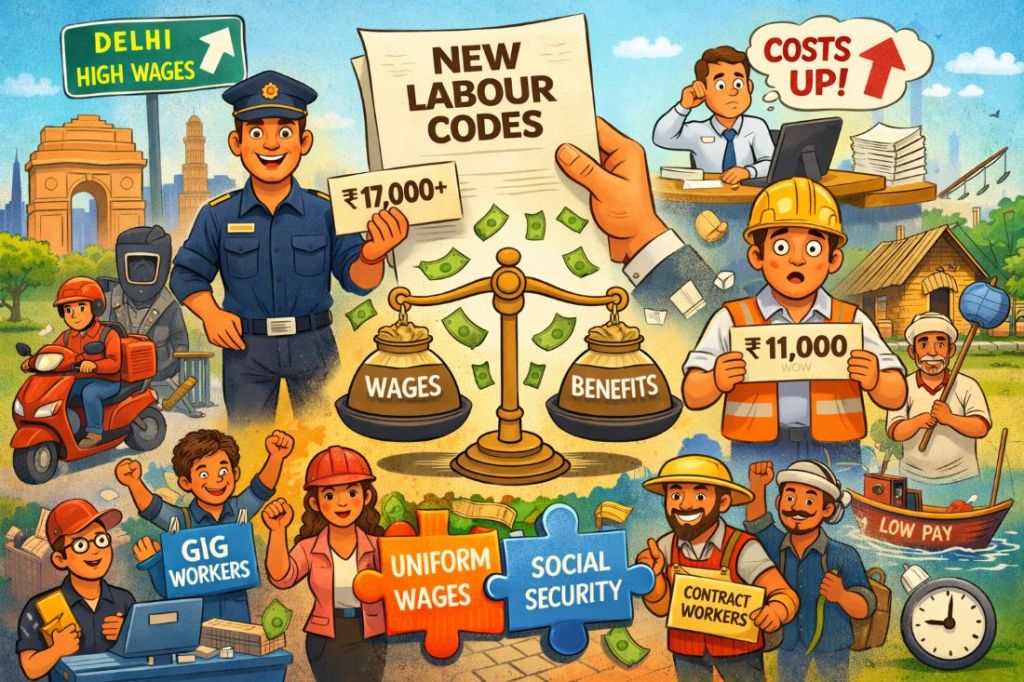
Last week, we discussed how the simplification of labour laws benefits employers. But simplification is not a one-sided gift. Employees, too, stand to gain — and in some cases, quite substantially.
Overlapping definitions and rules not only increased compliance costs, but employees often did not receive their legitimate benefits. Also, this encouraged many companies to outsource employees (often to less-compliant companies) to avoid the hassle.
The immediate impact of this is that many employees will see their wages rise, as benefits like gratuity will be available to all, and all benefits will now be calculated on the same wage scale.
Another major failing of the old labour laws was the sheer number of workers they managed to exclude. Entire categories of employees — particularly newer forms of work — simply didn’t exist.
Stepping back a moment, India has an estimated population of 1.46 billion (end 2025). Just over a billion are adults. And yet, we appear to have only 550 million people employed, including self-employed individuals – of whom nearly 250 million are farm workers. Chances are that many millions are simply not recorded.
The Internet, e-commerce, food delivery, cab aggregators and many new-age businesses now employ around 12-15 million gig workers, and NITI Aayog expects this to be 25 million by 2030.
All these folk will now be eligible for the same treatment. As will fixed-term wage earners and contract workers.
This has huge implications. Some of the most overworked and exploited workers will now be treated on par with others. For companies in new-age, human-service or delivery-based businesses, costs will increase substantially. Many of these firms don’t make profits anyway, so expect them to pass on these costs to customers.
And since the detailed rules are still unavailable, a period of confusion is inevitable — as regulators and companies alike wrestle with questions such as: who exactly is a gig worker, and how part-time work should be treated.
Today, active PF accounts number only a modest 75-80 million. The new labour codes could increase the total beneficiaries of formal, employment-linked social security to as much as 5x that number.
This is not incremental change – it’s structural!
Another interesting provision is the Central Minimum Wage. Till now, this applied only to employees of Central government-run entities. States could set their own minimum wages, which varied by geography, location and profession; and some states chose to keep them very low.
So there is wide variance, even across comparable (by cost of living) large cities or small towns. Delhi, Maharashtra, Karnataka tend to have higher minimums (on average) than other states. Bihar and UP are at the low end, though some North-Eastern states are at the bottom.
Now the Central Minimum Wage will set a floor, and all states will have to adhere to this minimum. Given that it will not be possible to reduce the Central Minimum Wage, we can expect that wages will rise in many states – at least for those at the bottom end.
Overall, wage uniformity and universal eligibility will boost the fortunes of workers, especially at the bottom of the pyramid. And way more than labour unions or other legislation have done in the past 75+ years!
At the same time, most businesses will face higher costs. Those who have been cautious, compliant and paid wages and benefits closer to the higher end of the slabs will be less affected. But the vast unorganised sector, contractors, sub-contractors and of course, the new-age players – will all have to deal with this new reality!
So when will all this happen, and how – well, you will have to wait for Part-3, next week. I’ve run out of space!

Leave a comment