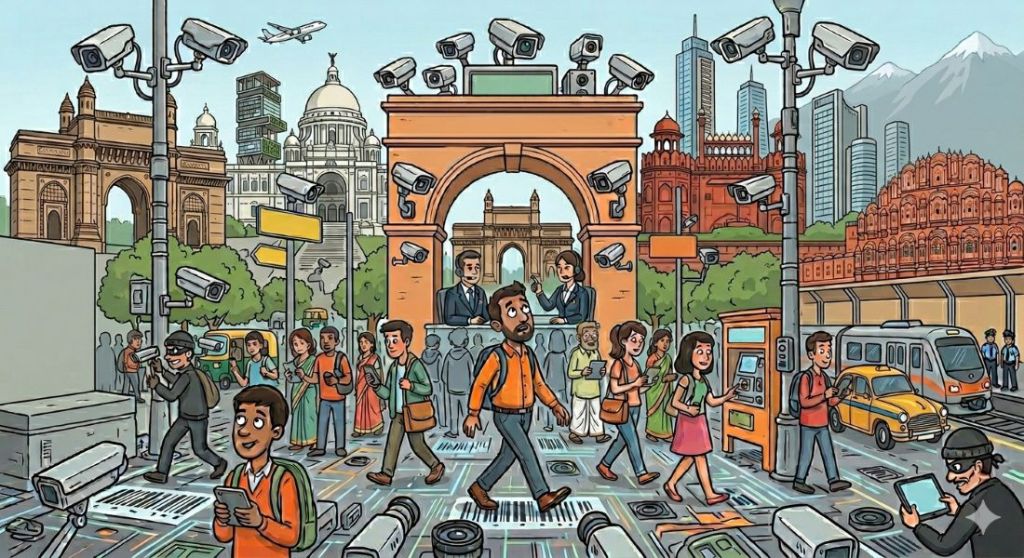
Even as we fret about the loss of privacy thanks to apps, government, social media, banks and hackers; a new dimension is quietly being hyper-enabled by AI.
And that’s the humble street camera.
Last week, I stumbled on a link that placed Indian cities among those with the largest CCTV camera networks.
Apparently, Hyderabad has 9 lakh+ cameras, Delhi around 5 lakh and Lucknow 4 lakh. All over India, cities are adding cameras at a furious pace, as are highways and private spaces like malls, restaurants, banks, offices and shops. An estimated 12-15 million CCTV cameras were sold in 2025, and growth is 20% per year.
Rough calculations suggest that the average person in Hyderabad may be clicked 50-100 times a day. In most areas, it’s hard to walk more than 500 meters without being photographed.
And this isn’t just India. Dubai, Singapore, London – in fact, all large cities are awash with cameras. Chinese cities are believed to have the densest networks, though numbers are not public.
What’s changed is not the cameras, but how we use them. AI, facial recognition, cloud, and 5G now allow feeds to be connected and analysed in real time.
There are clear benefits: improved enforcement of traffic rules, easier tracking of criminals and lost children, and so on. But that’s just the warm-up act.
- Governments no longer watch footage after the fact. In London and Singapore, the police anticipate violence using algorithms that flag “suspicious” behaviour, especially in crowded public spaces and sports stadiums.
- In Moscow and Pittsburgh, cameras dynamically adjust traffic lights based on vehicle count – cool, what?
- In Seoul, they help detect illegal trash disposal.
- In China and also some parts of the US and India, alerts are triggered when known criminals or “persons of interest” enter public spaces.
- Dubai’s Oyoon system integrates public and private feeds to map the location of every single car in real time. Drivers dare not break traffic rules, nor even drive “suspiciously”, i.e circle a sensitive building or airport. The system can manipulate traffic lights to lock you in till the cops arrive.
- China is in a league of its own. They can analyse emotions that indicate stress, hidden anger, or “hostile intent.” Photographs are instantly connected to payment history, social media or government records. They even know if you changed your satellite dish last week!
- Nigeria, Egypt, Kenya and several African countries have bought Chinese technology to track and arrest protesters and political activists.
- And it’s not just governments. Retailers identify customers and infer their social preferences and spending power. Healthcare providers analyse gait to diagnose Parkinsons’. Offices track movement, conversations, and time spent at the chai machine. HR tools screen candidates based on facial expressions, speech, tone, etc.
And if the technology exists, criminals will inevitably use it.
Some replace the live feed with a previously recorded image while committing a crime. They even use the tech to identify police presence or profile potential burglary targets. Ironically, your security camera might be helping plan a break-in!
In the past year, Indian authorities (CERT-In) warned against critical vulnerabilities in several brands of CCTV cameras. Last week, the government banned popular Chinese brands, citing security concerns.
It’s a strange paradox. We install cameras to feel safer without thinking about how many times we’re photographed, or who has access to the data. Apparently, even one non-secure camera can let hackers into the network. Ironic that security systems have so little security themselves!
This is not futuristic. It is already here. And the next wave of applications will make these look primitive.
Let’s face it. Privacy, or more accurately, anonymity, is dead. And no point fretting about it… the train has already left the station.
Just remember to smile – you’re on camera!

Leave a comment