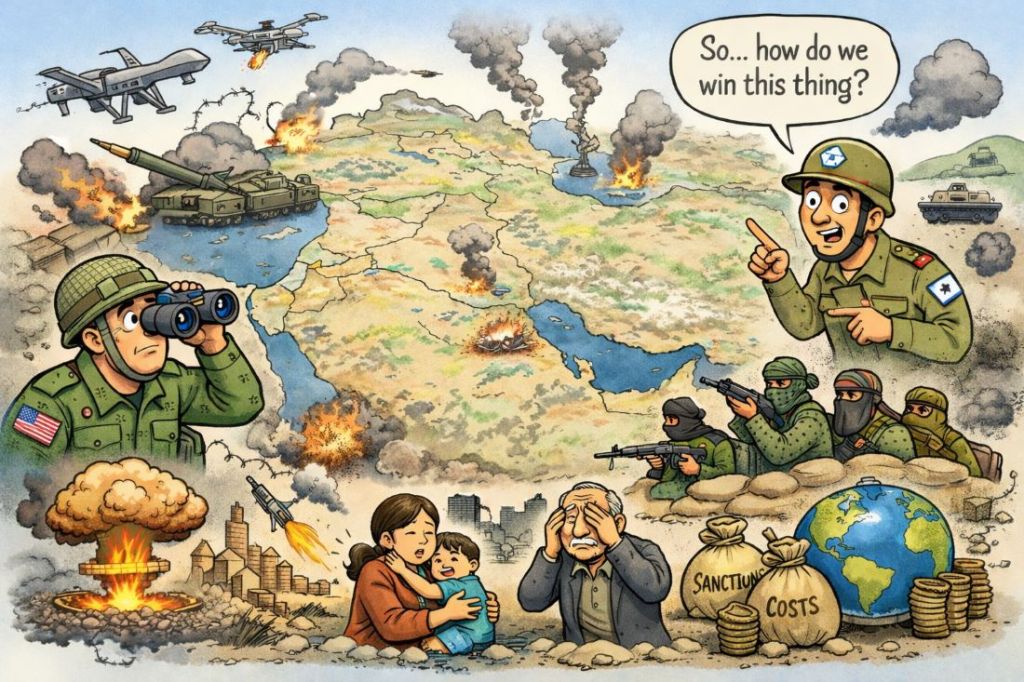
Military triumph may still be possible — but winning the peace is another matter.
As millions of screens flash images of burning buildings and refineries, missiles and drones; the media (as usual) is raking in the views. Opinions abound: the Iranian leader was an evil man, Trump is crazy, the markets will crash, oil will spike, shipping rates will skyrocket, and much more.
And along with the inevitable conspiracy theories, there is much debate about how long the US-Israel alliance will take to “win” the war.
This got me thinking – in today’s world, can wars even be won?
Increasingly, the answer seems to be no — at least not in the clean, decisive way wars used to be won.
In the old days, two armies fought. Eventually, one was overpowered or surrendered, and the war was won. The losing king usually lost his head and empire, so regime change was effected. This model seemed to work till roughly the end of the Second World War.
Today’s wars are quite different. They are increasingly fought by remote control, using missiles and drones. These can lead to decisive outcomes if the engagements are short, one side is vastly superior, and the objectives are limited. This was evident in the Kuwait war and the Azerbaijan-Armenia conflict.
However, wars that involve territorial occupation tend to result in painful stalemates. This happened in Vietnam and Afghanistan, and is now playing out in Ukraine.
Even when one side is clearly victorious, sustaining the gains is much harder. The losing side rarely disappears, but typically fights an asymmetric guerrilla war that exhausts the victor. Afghanistan and Iraq are good examples of this.
In Iran, the US-Israeli strategy appears to be to weaken the existing regime, and then let the local population do the cleaning up. But this is easier said than done. The supporters of the current rulers won’t go away, and this could well result in a long, drawn-out civil war.
So, what’s the point?
Note that the above, somewhat dispassionate arguments haven’t even mentioned the humongous human costs of loss of civilian lives and property.
Add these huge costs to outcome uncertainty, and the whole exercise seems even more pointless.
Possibly, I am naïve and idealistic. Maybe so.
But if anyone can explain why we still seem so eager to start wars that nobody can truly win, I would genuinely like to hear it.

Leave a comment