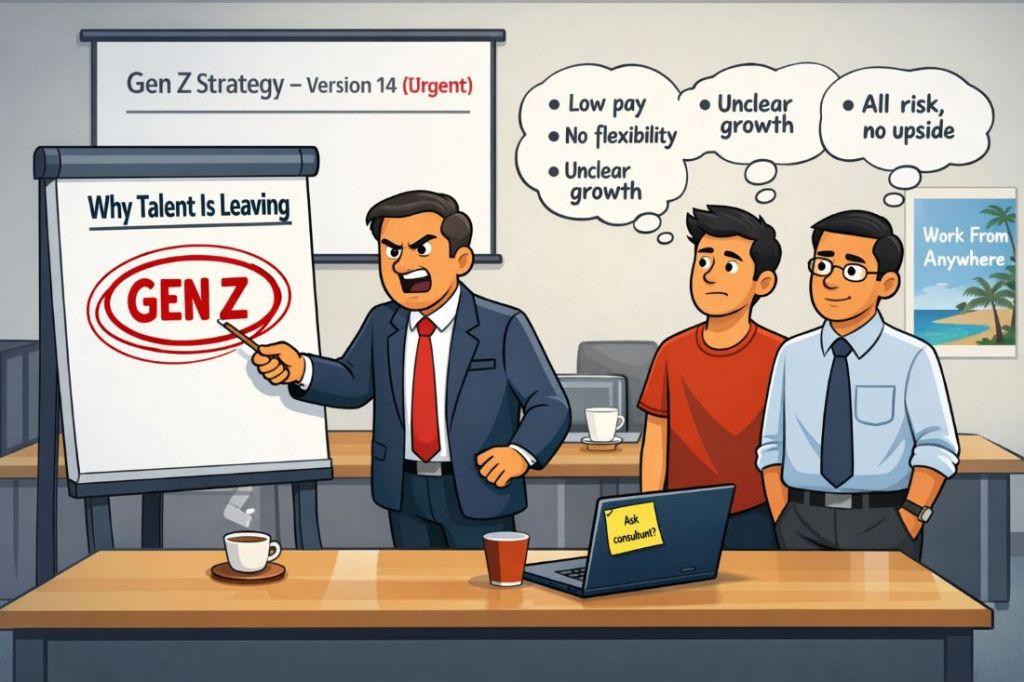
Marketing and management conversations often turn complex ideas into neat labels, and segmenting people into categories is a favourite tactic. We now have labels like aspirational, digital native, purpose-driven, urban millennial, and so on. It makes managers sound knowledgeable and helps create neat stories – and even neater PowerPoint slides.
These classifications can make sense in certain limited use cases. The problem is that they rarely stay limited. Thanks to good storytelling and even better amplification, they quickly become universal truths.
Take Gen Z.
We are repeatedly told that Gen Z is allergic to authority, jumps jobs frequently, hates corporate employment, values purpose over pay, and “meaning” over security. According to this view, traditional employment is becoming obsolete because young workers simply do not want it.
It’s a compelling story.
It’s also an incomplete one, and we may simply be extrapolating from a small, visible, and unusually loud cohort.
The reality is much more nuanced – and often contradictory – especially in India. I have met many young adults who fit the Gen Z stereotype. But my own hiring experience suggests that many twenty-year-olds valued job security as much as flexibility.
Gen Z, after all, is defined by age (born between 1997 and 2012). Treating it as a homogenous group (especially in attitudes) is a concept born in the West, primarily the US. Indian media and marketing discourse have gladly adopted this as a universal truth.
The desire to live like a digital nomad is not merely an attribute of age, but one of economic constraints. If you have savings, family support, or in-demand skills; gig work provides the freedom to live in Goa, while Instagramming about work-life balance.
If, on the other hand, you are repaying education loans, supporting family members, and have no meaningful safety net, a secure full-time job provides something more valuable than “purpose”- it lets you sleep at night.
Skills matter too. Some skills travel well across employers, clients and geographies. Others are tied to institutions or systems. The more portable your skills, the more optionality you have. None of this changes dramatically because you were born in 1998 instead of 1988.
In other words, what we call “Gen Z behaviour” is just rational decision-making. People don’t choose gig work because they are Gen Z. They choose it when they can afford uncertainty.
Struggling to get or keep talent, employers often blame Gen Z attitudes. It’s convenient, saves introspection – and can be sold to the boss!
Yes, the internet and Covid have permanently changed expectations around flexibility and work-from-home. That genie isn’t going back into the bottle. The problem is not that people don’t want jobs, but in how work is structured – in terms of rigidity, learning, career progression, risk and reward.
And for the record, this isn’t just Gen Z. Older employees want flexibility too – they’re just not as vocal on social media.
Would love to hear your views, and please share, re-post or like.

Leave a comment